Inner-Loop-Free Total-Variation-Constrained Full-Waveform Inversion
IEEE Signal Processing Letters, 2026
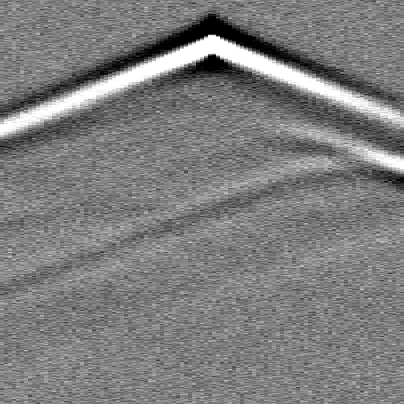
Observed seismic signal
1 of 20 sources · 101 receivers
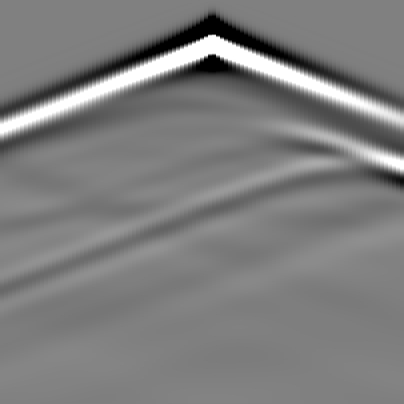
Initial model

Reconstruction (proposed, α = 350)
Ground truth


- SSIM
- 0.6707
- RMSE
- 309.92 m/s
- SSIM
- 0.6559
- RMSE
- 307.75 m/s
Highlights
A primal-dual splitting (PDS) based algorithm that handles the TV and box constraints directly, with neither approximations nor inner loops.
近似も内部ループも用いずに、TV 制約と box 制約を直接扱う、主-双対近接分離法(PDS)に基づくアルゴリズム。
Per iteration, the constraints are handled in , so the computational cost is dominated by the gradient computation (wave-equation simulation).
1 反復あたりの制約の処理は で済むため、計算コストは勾配計算(波動方程式のシミュレーション)が支配的となる。
On the SEG/EAGE Salt Model, it suppresses the wave-like artifacts seen in standard FWI, and even with noisy observations its SSIM does not degrade as iterations proceed.
SEG/EAGE Salt Model において、標準的な FWI に現れる波状のアーティファクトを抑制し、ノイズを含む観測に対しても反復を重ねることによる SSIM の劣化が生じない。
Abstract
This paper proposes a computationally efficient algorithm to address the Full-Waveform Inversion (FWI) problem with a Total Variation (TV) constraint, designed to accurately reconstruct subsurface properties from seismic signal. FWI, as an ill-posed inverse problem, requires effective regularizations or constraints to ensure accurate and stable solutions. Among these, the TV constraint is widely known as a powerful prior for modeling the piecewise smooth structure of subsurface properties. However, solving the optimization problem is challenging because of the nonlinear observation process combined with the non-smoothness of the TV constraint. Conventional methods rely on inner loops and/or approximations, which lead to high computational cost and/or inappropriate solutions. To address these limitations, we develop a novel algorithm based on a primal-dual splitting method, achieving computational efficiency by eliminating inner loops and ensuring high accuracy by avoiding approximations. We also demonstrate the effectiveness of the proposed method through experiments using the SEG/EAGE Salt Model.
本論文では、地震波信号から地下の物性を高精度に再構成することを目的として、全変動(Total Variation: TV)制約付きのフルウェーブフォームインバージョン(Full-Waveform Inversion: FWI)問題を解く、計算効率の高いアルゴリズムを提案する。FWI は不良設定逆問題であり、高精度かつ安定な解を得るためには効果的な正則化または制約が必要である。その中でも TV 制約は、地下物性の区分的に滑らかな構造をモデル化する強力な事前情報として広く知られている。しかし、非線形な観測過程と TV 制約の非平滑性が組み合わさるため、この最適化問題を解くことは容易ではない。従来手法は内部ループや近似に依存しており、計算コストの増大や不適切な解を招く。これらの限界に対処するため、本論文では主-双対近接分離法に基づく新たなアルゴリズムを開発する。本手法は、内部ループを排除することで計算効率を達成し、近似を避けることで高い精度を確保する。さらに、SEG/EAGE Salt Model を用いた実験により、提案手法の有効性を示す。
Method
Here is the velocity model on grid points, is the observed seismic signal, and is the signal simulated by the wave equation. The TV constraint promotes piecewise-smooth models, and the box constraint keeps the velocity within . Writing both constraints as indicator functions, the problem fits the PDS framework: each iteration needs only the FWI gradient and projections onto the box and the -norm ball, which require no inner loop.
Results
Noiseless
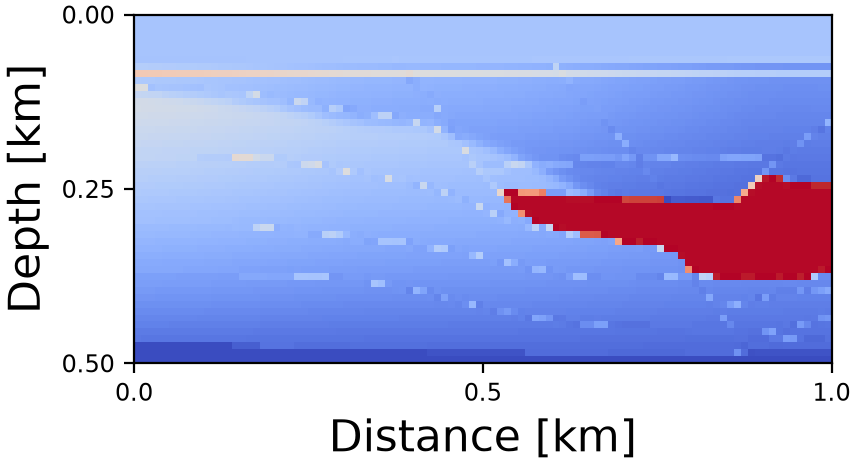
Ground truth
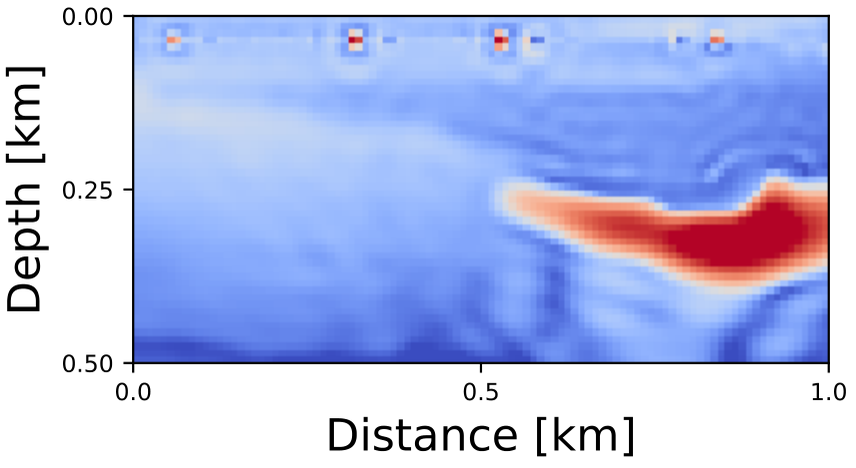
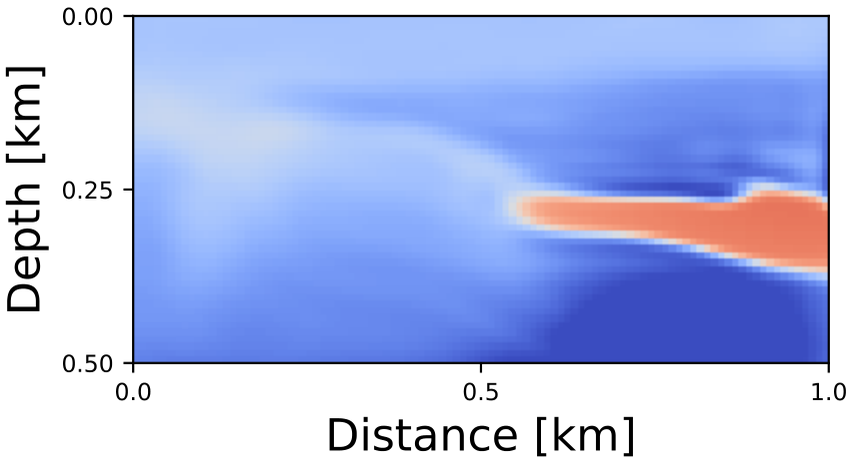
Standard FWI
347.80 / 0.6100
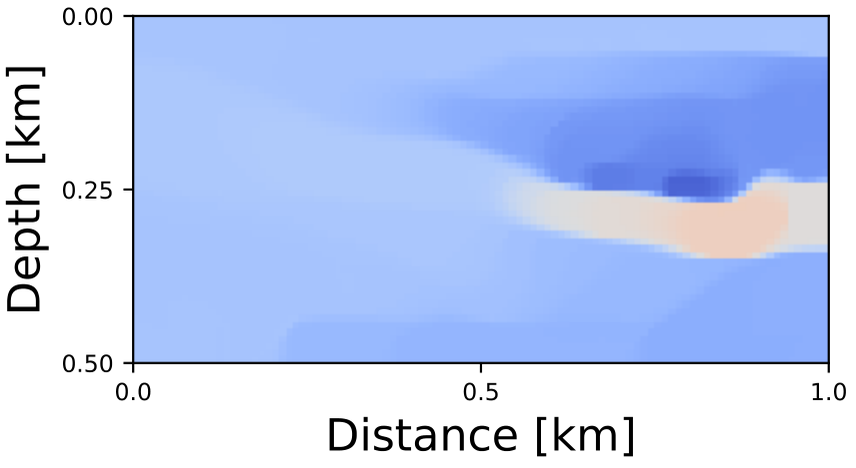
NN-FWI
449.81 / 0.7706
Ours (α = 150)
553.77 / 0.5229
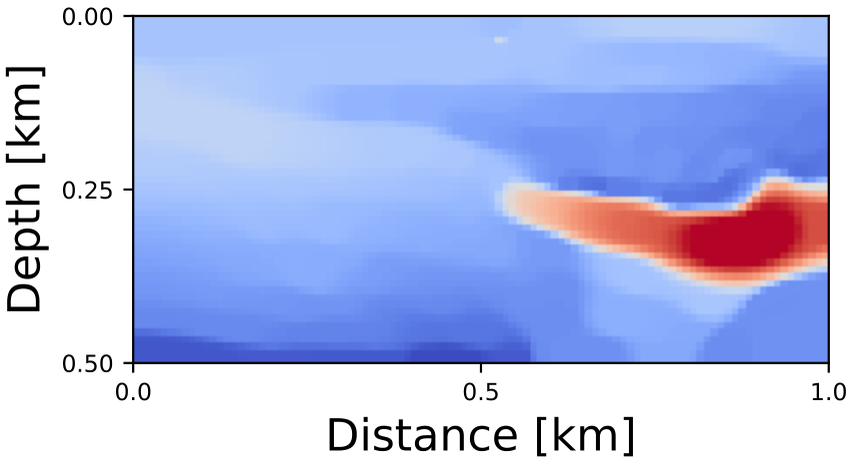
Ours (α = 350)
309.92 / 0.6707
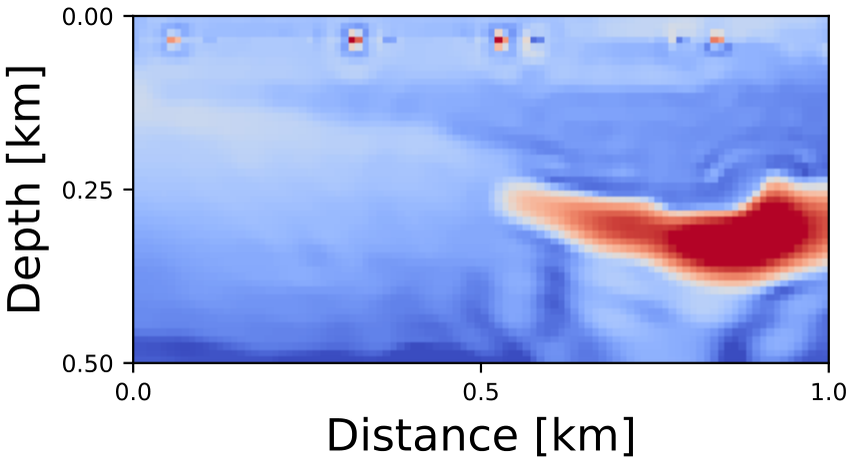
Ours (α = 550)
339.92 / 0.6214
Noisy (σ = 1)
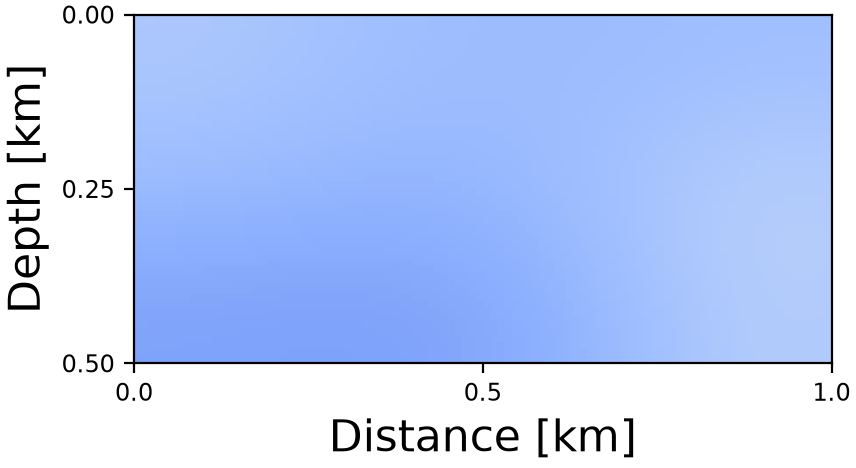
Initial model
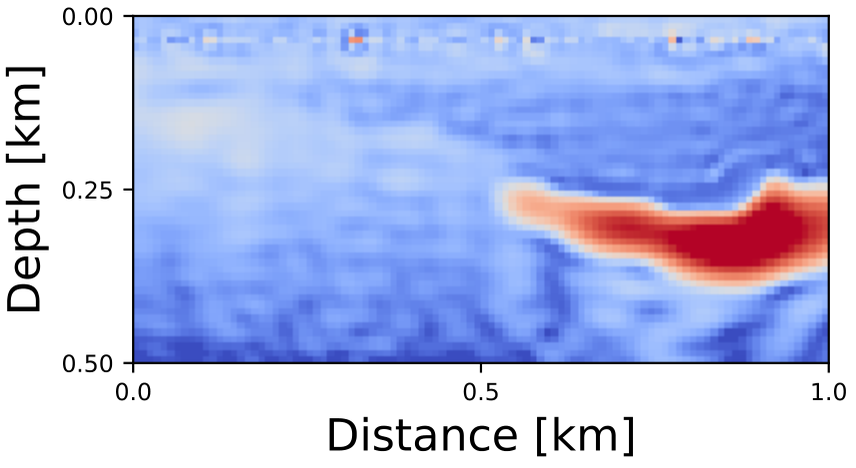
Standard FWI
345.68 / 0.5342
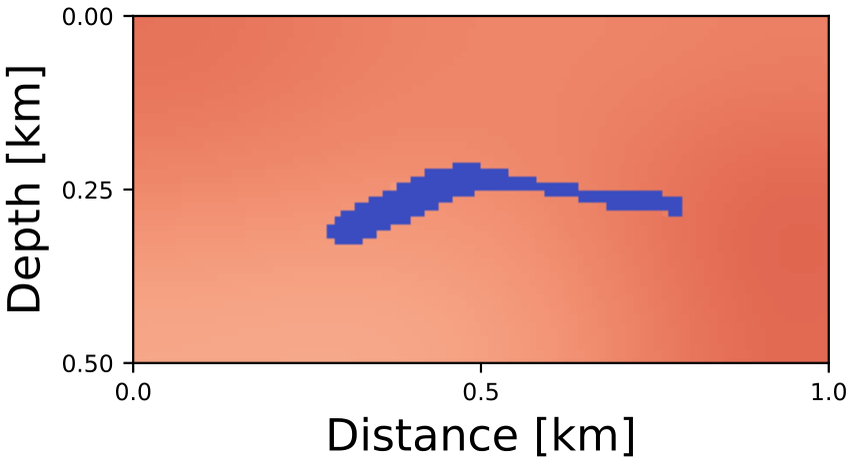
NN-FWI
1481.53 / 0.2616
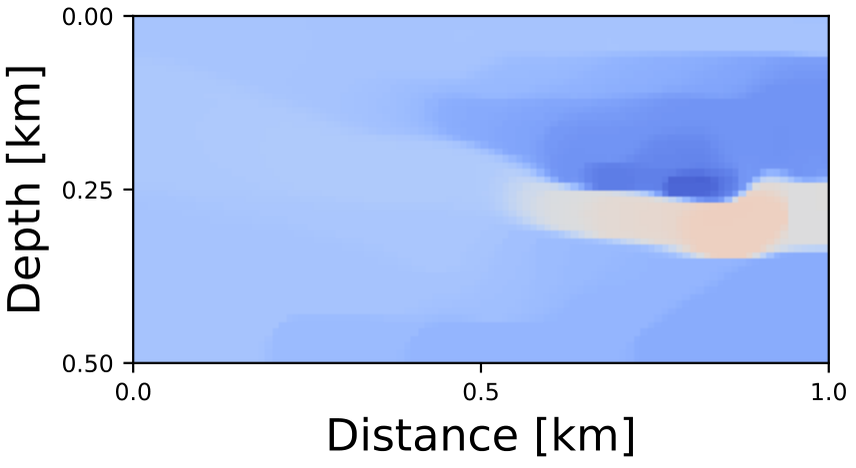
Ours (α = 150)
554.59 / 0.5230
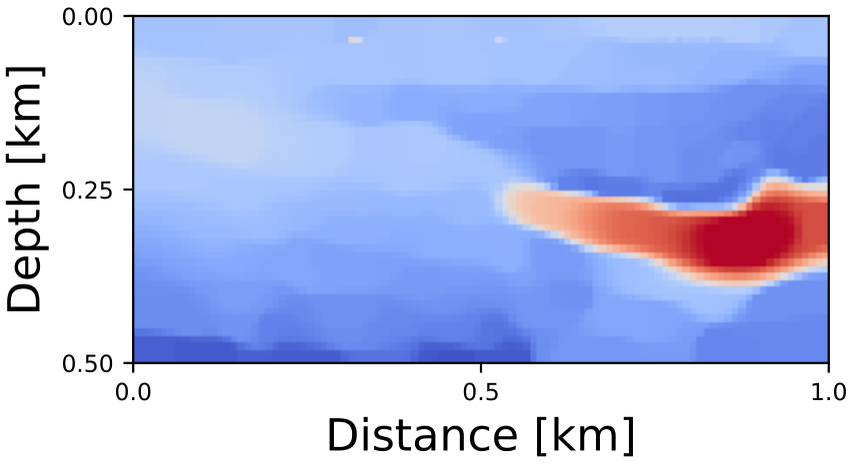
Ours (α = 350)
307.75 / 0.6559
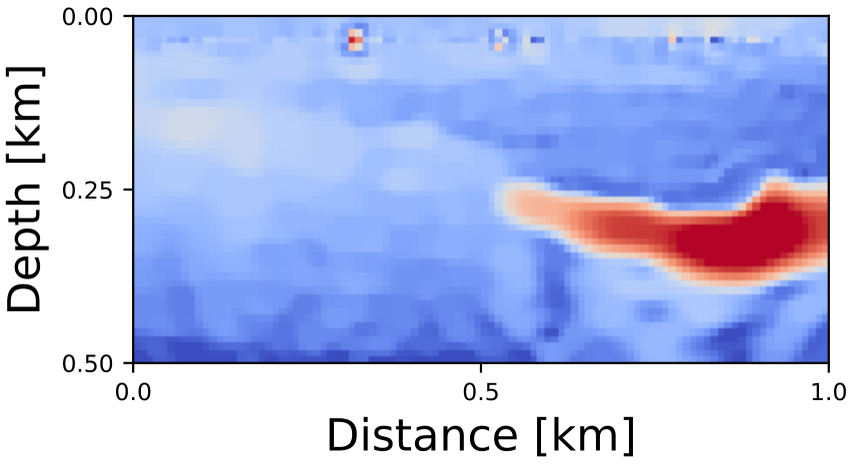
Ours (α = 550)
339.33 / 0.5896
Velocity [km/s]
Citation
@article{takemoto2026innerloopfree,
  author  = {Takemoto, Shingo and Ono, Shunsuke},
  title   = {Inner-Loop-Free Total-Variation-Constrained Full-Waveform Inversion},
  journal = {IEEE Signal Processing Letters},
  year    = {2026},
  doi     = {10.1109/LSP.2026.3740643}
}