Spatio-Spectral Structure Tensor Total Variation for Hyperspectral Image Denoising and Destriping
IEEE Journal of Selected Topics in Applied Earth Observations and Remote Sensing, vol. 18, pp. 19157–19175, 2025
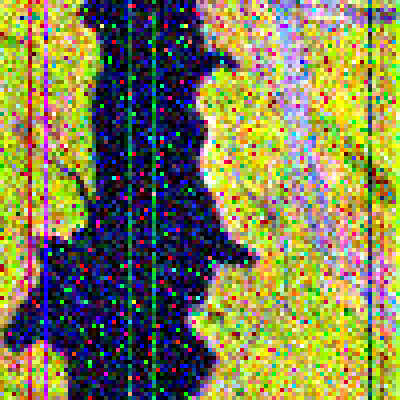
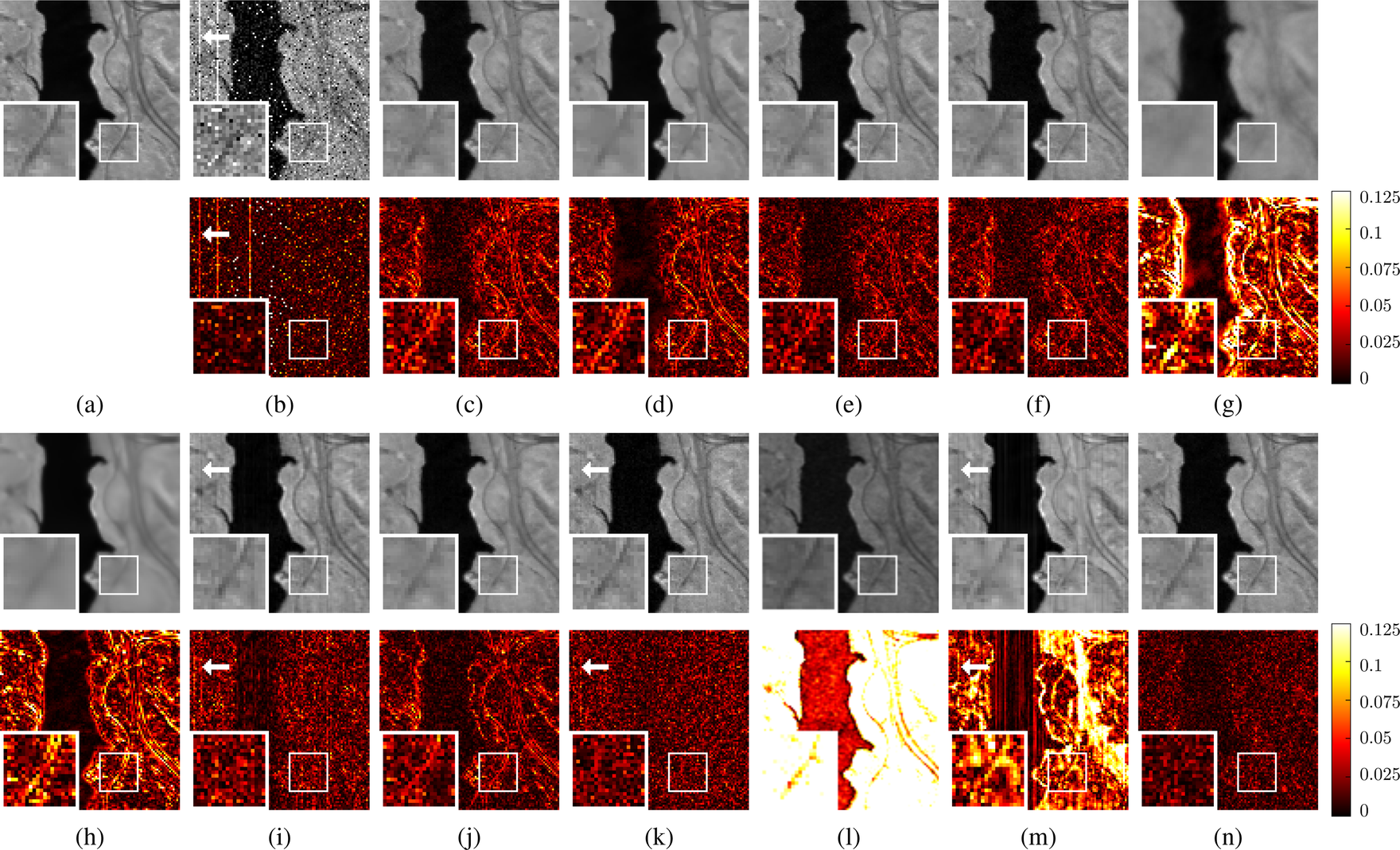
Observed
bands 101 / 61 / 31 (RGB), [0, 1]
iteration 775 / 775 · MPSNR 35.7 dB
= Restored
bands 101 / 61 / 31 (RGB), [0, 1]
+ Sparse noise

= Restored
bands 101 / 61 / 31 (RGB), [0, 1]
+ Sparse noise
+ Stripe noise
+ Gaussian noise
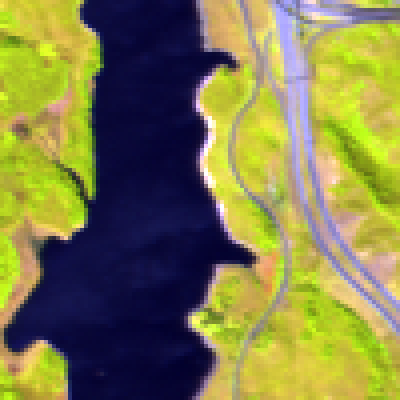
Ground truth
- MPSNR
- 36.05 dB
- MSSIM
- 0.9257
Highlights
We propose S3TTV, a new regularization defined as the sum of the nuclear norms of structure tensors built from second-order spatio-spectral differences. It simultaneously captures three priors of HS images (piecewise smoothness, similarity between adjacent bands, and correlation across all bands within small areas) while avoiding over-smoothing.
2 階の空間-スペクトル差分から構成した構造テンソルの核ノルムの和として定義される、新しい正則化 S3TTV を提案する。区分的滑らかさ・隣接バンドの類似性・小領域内での全バンドの相関という HS 画像に関する 3 つの事前知識を同時に捉えつつ、過平滑化を避ける。
We formulate HS image denoising with S3TTV as a constrained convex optimization problem. By imposing the terms that characterize Gaussian, sparse, and stripe noise as separate constraints, their parameters can be set independently of each other.
S3TTV を用いた HS 画像のノイズ除去問題を、制約付き凸最適化問題として定式化する。ガウスノイズ・スパースノイズ・ストライプノイズを特徴づける項をそれぞれ制約として課すことで、各パラメータを互いに独立に決定できる。
We design an algorithm that solves this problem efficiently, based on the preconditioned primal-dual splitting method (P-PDS), whose step sizes are determined automatically.
ステップサイズを自動で決定できる前処理付き主-双対近接分離法(P-PDS)に基づき、この問題を効率的に解くアルゴリズムを設計する。
Abstract
This article proposes a novel regularization method, named spatio-spectral structure tensor total variation (S3TTV), for denoising and destriping hyperspectral (HS) images. HS images are inevitably contaminated by various types of noise during acquisition process due to the measurement equipment and the environment. For HS image denoising and destriping tasks, spatio-spectral total variation (SSTV) is widely known as a powerful regularization approach that models the spatio-spectral piecewise smoothness. However, since SSTV refers only to the local differences of pixels/bands, edges and textures that extend beyond adjacent pixels are not preserved during denoising process. To address this problem, we newly introduce S3TTV, which is designed to preserve two essential physical characteristics of HS images: semilocal spatial structures and spectral correlation across all bands. Specifically, we define S3TTV as the sum of the nuclear norms of spatio-spectral structure tensors, which are matrices formed by arranging second-order spatio-spectral difference vectors within semilocal areas. Furthermore, we formulate the HS image denoising and destriping problem as a constrained convex optimization problem involving S3TTV and develop an algorithm based on a preconditioned primal-dual splitting method to solve this problem efficiently. Finally, we demonstrate the effectiveness of S3TTV by comparing it with existing methods, including state-of-the-art ones through denoising and destriping experiments.
本論文では、ハイパースペクトル(HS)画像のノイズ除去およびストライプノイズ除去のための新たな正則化手法として、空間-スペクトル構造テンソル全変動(spatio-spectral structure tensor total variation: S3TTV)を提案する。HS 画像は、計測機器や環境に起因して、取得の過程でさまざまな種類のノイズに不可避的に汚染される。HS 画像のノイズ除去およびストライプノイズ除去では、空間-スペクトル方向の区分的滑らかさをモデル化する強力な正則化手法として、空間-スペクトル全変動(SSTV)が広く知られている。しかし、SSTV は画素・バンド間の局所的な差分のみを参照するため、隣接画素を越えて広がるエッジやテクスチャはノイズ除去の過程で保持されない。この問題に対処するため、本論文では、HS 画像の本質的な 2 つの物理的特性である半局所的な空間構造と全バンドにわたるスペクトル相関を保持するよう設計した S3TTV を新たに導入する。具体的には、半局所領域内の 2 階の空間-スペクトル差分ベクトルを並べて構成した行列である空間-スペクトル構造テンソルの核ノルムの和として、S3TTV を定義する。さらに、HS 画像のノイズ除去およびストライプノイズ除去の問題を、S3TTV を含む制約付き凸最適化問題として定式化し、この問題を効率的に解くために、前処理付き主-双対近接分離法に基づくアルゴリズムを開発する。最後に、最先端の手法を含む既存手法とノイズ除去およびストライプノイズ除去の実験で比較することにより、S3TTV の有効性を示す。
Design principle
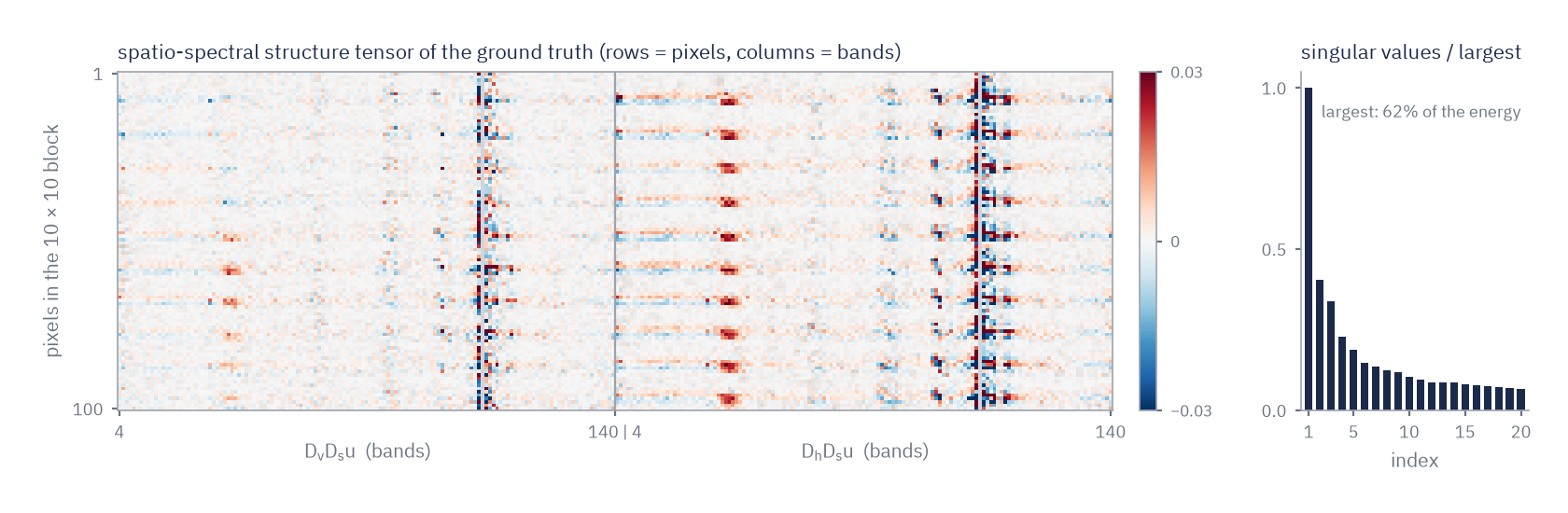
Second-order spatio-spectral differences of an HS image are small except at edges, and they are similar between adjacent bands. In addition, within a small area, pixels that have large differences in one band tend to have large differences in the other bands as well. Arranging the differences in the th block into the spatio-spectral structure tensor (rows = pixels, columns = bands) therefore gives a matrix whose columns are close to multiples of a few patterns, i.e., it is approximately low rank. S3TTV characterizes this low-rank structure in every block through the nuclear norm, .
Method
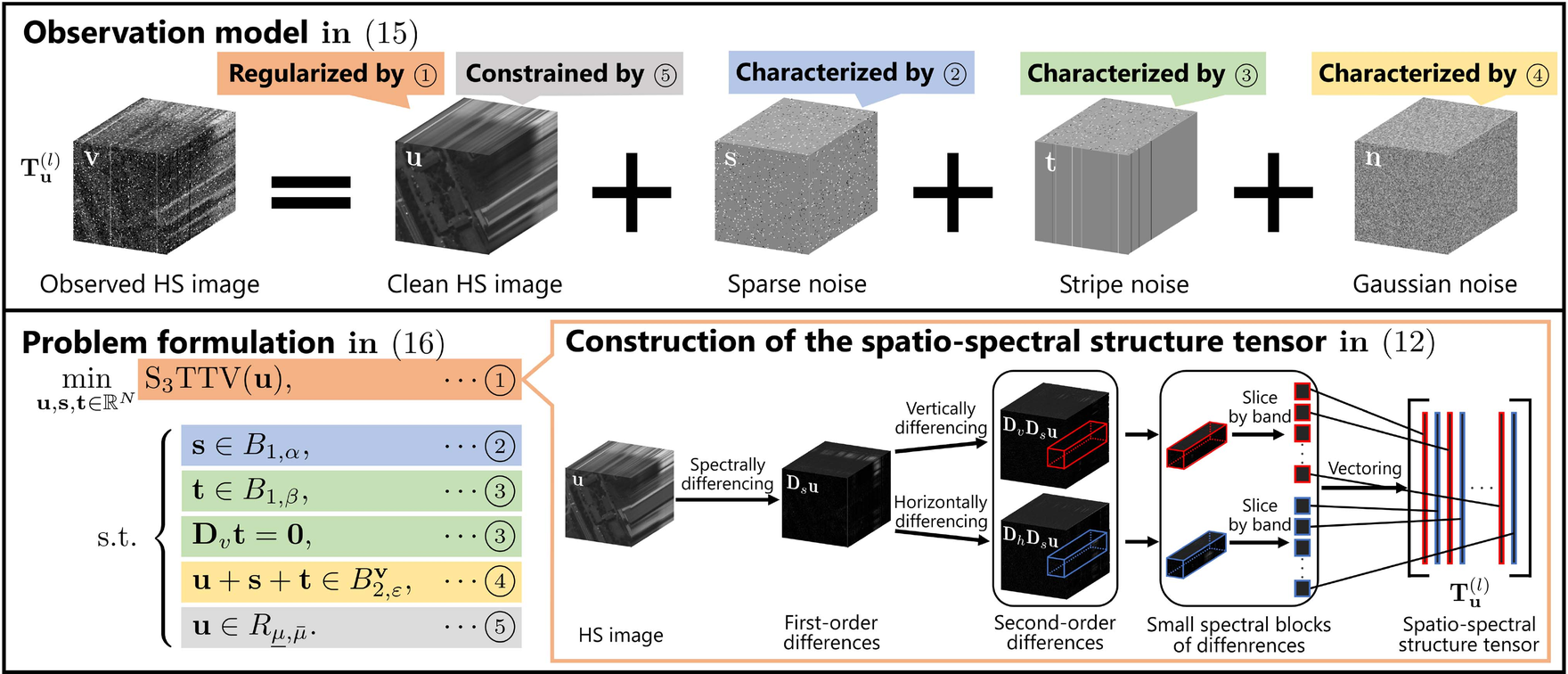
The observation is modeled as . Here is the spectral difference operator, and are the vertical and horizontal difference operators, and extracts the th small spectral block. S3TTV regularizes the clean image , the -balls bound the sparse noise and the stripe noise , enforces the vertical flatness of stripes, the -ball serves as data fidelity, and the box keeps in its dynamic range. The problem is solved by P-PDS, whose step sizes are determined automatically.
Results
| Method | Jasper Ridge | Pavia University | Beltsville | |||
|---|---|---|---|---|---|---|
| MPSNR | MSSIM | MPSNR | MSSIM | MPSNR | MSSIM | |
| SSTV | 34.68 | 0.9129 | 33.06 | 0.8788 | 33.07 | 0.8757 |
| HSSTV1 | 34.22 | 0.9136 | 33.53 | 0.8923 | 33.92 | 0.8967 |
| HSSTV2 | 35.15 | 0.9183 | 33.62 | 0.8869 | 33.20 | 0.8767 |
| l0-l1HTV | 34.27 | 0.8958 | 32.83 | 0.8731 | 32.65 | 0.8687 |
| STV | 26.79 | 0.7050 | 27.22 | 0.6649 | 27.65 | 0.6586 |
| SSST | 30.99 | 0.8484 | 30.80 | 0.8210 | 30.82 | 0.8255 |
| LRTDTV | 33.49 | 0.8807 | 30.84 | 0.8127 | 30.44 | 0.7891 |
| FGSLR | 33.07 | 0.9084 | 31.67 | 0.8807 | 33.94 | 0.9053 |
| TPTV | 33.15 | 0.8530 | 31.13 | 0.8068 | 32.31 | 0.8268 |
| QRNN3D | 23.22 | 0.7787 | 30.74 | 0.8900 | 27.29 | 0.8250 |
| FastHyMix | 23.17 | 0.6000 | 31.79 | 0.8726 | 33.23 | 0.9017 |
| S3TTV | 36.05 | 0.9257 | 34.33 | 0.9029 | 34.42 | 0.9021 |
Citation
@ARTICLE{takemoto2025spatiospectral,
  author={Takemoto, Shingo and Naganuma, Kazuki and Ono, Shunsuke},
  journal={IEEE Journal of Selected Topics in Applied Earth Observations and Remote Sensing},
  title={Spatio-Spectral Structure Tensor Total Variation for Hyperspectral Image Denoising and Destriping},
  year={2025},
  volume={18},
  number={},
  pages={19157-19175},
  doi={10.1109/JSTARS.2025.3586779}
}